Skip Counting
0, 5, 10, 15, 20, 25, 30, 35, 40, 45, 50
What comes next?
What is skip counting?
Skip counting is counting forward by the same number each time: by 2s (2, 4, 6, 8…), by 5s (5, 10, 15, 20…) or by 10s (10, 20, 30…). Each count is one jump of the same size along the number line, which is why it’s the bridge from counting to multiplication: three jumps of 4 land on 12, and 3 × 4 = 12.
The order to learn it
- 10s first: every number ends in 0, and it matches the tens on a hundreds chart.
- 5s next: the numbers end in 5, 0, 5, 0, and they come up with clocks and nickels.
- 2s: the even numbers. Counting by 2s from 1 gives the odd numbers.
- 3s and 4s, usually in 2nd or 3rd grade, as the lead-in to those times tables.
- 25s and 100s for money (quarters) and place value.
Starting somewhere other than zero is the real test: counting by 10s from 13 (13, 23, 33…) shows a child understands that only the tens digit changes.
Skip counting chart
Each row counts on by one number, ten times. Read across and it’s skip counting; read the last column and it’s the ×10 facts. The whole chart is the multiplication chart in disguise.
| by 2s | 2 | 4 | 6 | 8 | 10 | 12 | 14 | 16 | 18 | 20 |
|---|---|---|---|---|---|---|---|---|---|---|
| by 3s | 3 | 6 | 9 | 12 | 15 | 18 | 21 | 24 | 27 | 30 |
| by 4s | 4 | 8 | 12 | 16 | 20 | 24 | 28 | 32 | 36 | 40 |
| by 5s | 5 | 10 | 15 | 20 | 25 | 30 | 35 | 40 | 45 | 50 |
| by 6s | 6 | 12 | 18 | 24 | 30 | 36 | 42 | 48 | 54 | 60 |
| by 7s | 7 | 14 | 21 | 28 | 35 | 42 | 49 | 56 | 63 | 70 |
| by 8s | 8 | 16 | 24 | 32 | 40 | 48 | 56 | 64 | 72 | 80 |
| by 9s | 9 | 18 | 27 | 36 | 45 | 54 | 63 | 72 | 81 | 90 |
| by 10s | 10 | 20 | 30 | 40 | 50 | 60 | 70 | 80 | 90 | 100 |
Skip counting worksheets
Free one-page PDFs, each with an answer key on page 2.
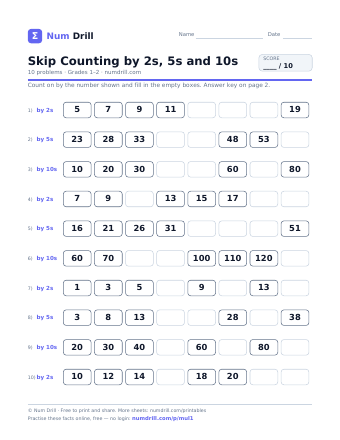
Skip Counting by 2s, 5s and 10s
Grades 1–2
Ten rows to finish by counting on in 2s, 5s and 10s, some starting off the tens.
Download PDF (10 problems · 51 KB)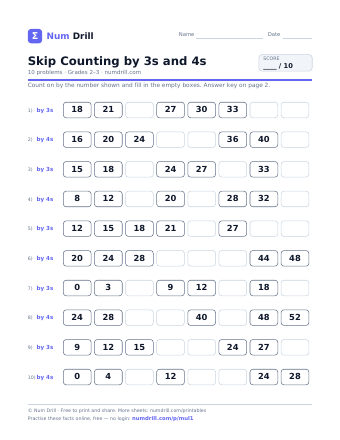
Skip Counting by 3s and 4s
Grades 2–3
Ten rows counting on in 3s and 4s: the patterns behind the 3 and 4 times tables.
Download PDF (10 problems · 51 KB)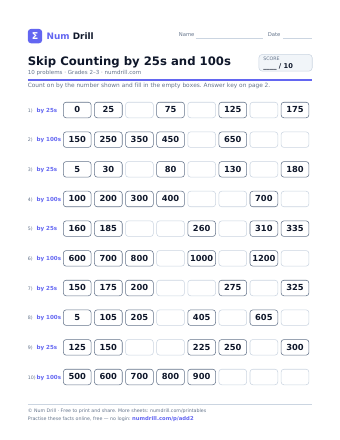
Skip Counting by 25s and 100s
Grades 2–3
Ten rows counting in 25s (quarters) and 100s, some starting off the hundreds.
Download PDF (10 problems · 51 KB)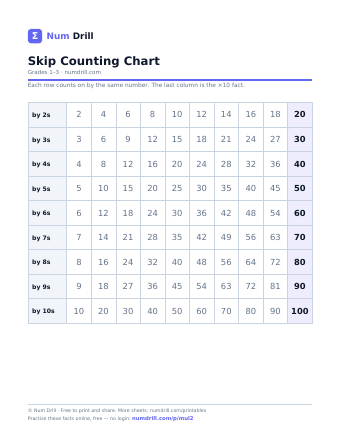
Skip Counting Chart
Grades 1–3
Counting by 2s to 10s, ten skips each: the times tables in disguise.
Download PDF (45 KB)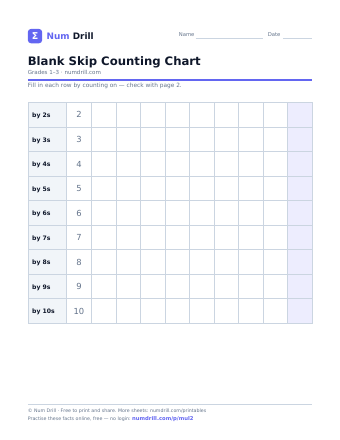
Blank Skip Counting Chart
Grades 1–3
The same chart with only the first number in each row. Filled chart on page 2.
Download PDF (47 KB)From skip counting to multiplication
Once a child can skip count by a number without stopping, they know that times table in order. The next step is jumping straight to any fact (what is 7 × 4?) without counting up from the start. That takes practice out of order, which is what the times table worksheets and a short daily quiz are for.
Ready for the times tables?
A 10-question quiz takes about a minute and starts with the easy tables. No login.
Times tables 1–5 quiz Times tables 1–10 quizCommon questions
What is skip counting?
Skip counting means counting forward by the same number each time, such as by 2s (2, 4, 6, 8), by 5s (5, 10, 15, 20) or by 10s (10, 20, 30). It is the first step towards multiplication.
What grade learns skip counting?
Kindergarten and 1st grade count by 10s, 2nd grade skip counts by 5s, 10s and 100s within 1,000, and skip counting by 2s, 3s and 4s supports the times tables in 2nd and 3rd grade.
How does skip counting help with multiplication?
Each skip is one group. Counting by 4s three times (4, 8, 12) is the same as 3 × 4 = 12, so a child who can skip count by 4s already knows the 4 times table in order.
What order should kids learn skip counting in?
10s, then 5s, then 2s, then 3s and 4s, then 25s and 100s for money and place value. Practise starting from numbers other than zero too.
Are the skip counting worksheets free?
Yes. All the skip counting worksheets and charts are free PDFs with answer keys, with no login or sign-up.
Related: hundreds chart · number line · times tables practice · multiplication worksheets · 2nd grade math