Number Bonds
A number bond shows how a number splits into two parts. The whole sits in the top circle and the two parts below it: 10 splits into 7 and 3, so 7 + 3 = 10 and 10 − 7 = 3.
The number bonds to 10 are 0 + 10, 1 + 9, 2 + 8, 3 + 7, 4 + 6 and 5 + 5, plus the same pairs turned around.
Number bond explorer
Change the whole and move the counters between the two parts.
3 + 7 = 10 · 10 − 3 = 7
Number bonds to 10
The eleven ways to make 10. They are the most useful facts in early addition: to add 8 + 5, take 2 from the 5 to make 10, and 10 + 3 = 13.
- 0 + 10
- 1 + 9
- 2 + 8
- 3 + 7
- 4 + 6
- 5 + 5
- 6 + 4
- 7 + 3
- 8 + 2
- 9 + 1
- 10 + 0
Number bonds to 20
Every bond to 10 has a partner with ten added to one part: 3 + 7 = 10, so 13 + 7 = 20 and 3 + 17 = 20.
- 0 + 20
- 1 + 19
- 2 + 18
- 3 + 17
- 4 + 16
- 5 + 15
- 6 + 14
- 7 + 13
- 8 + 12
- 9 + 11
- 10 + 10
- 11 + 9
- 12 + 8
- 13 + 7
- 14 + 6
- 15 + 5
- 16 + 4
- 17 + 3
- 18 + 2
- 19 + 1
- 20 + 0
Practice: find the missing number
Press Enter to check.
Doubles facts
A doubles fact adds a number to itself: a number bond with two equal parts. Doubles are usually the first facts children know by heart, and they unlock the near doubles: 6 + 7 is 6 + 6 and one more, so 13.
- 1 + 1 = 2
- 2 + 2 = 4
- 3 + 3 = 6
- 4 + 4 = 8
- 5 + 5 = 10
- 6 + 6 = 12
- 7 + 7 = 14
- 8 + 8 = 16
- 9 + 9 = 18
- 10 + 10 = 20
- 11 + 11 = 22
- 12 + 12 = 24
Every double is an even number, and doubling is the same as multiplying by 2, so the doubles are also the 2 times table. Print the doubles and near doubles worksheet for practice.
Number bond worksheets
Free PDFs with an answer key on page 2. No login, no email.
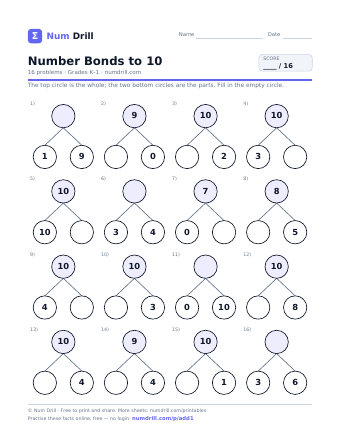
Number Bonds to 10
Grades K–1
Sixteen part-part-whole bonds within 10, half of them making 10. Fill in the empty circle.
Download PDF (16 problems · 52 KB)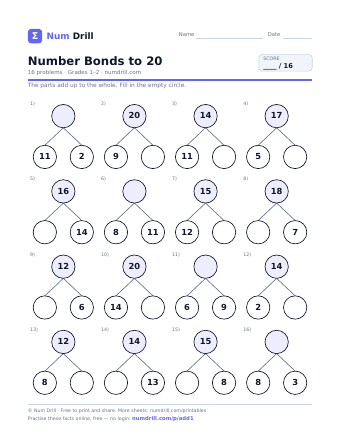
Number Bonds to 20
Grades 1–2
Sixteen part-part-whole bonds with wholes from 11 to 20. Fill in the empty circle.
Download PDF (16 problems · 52 KB)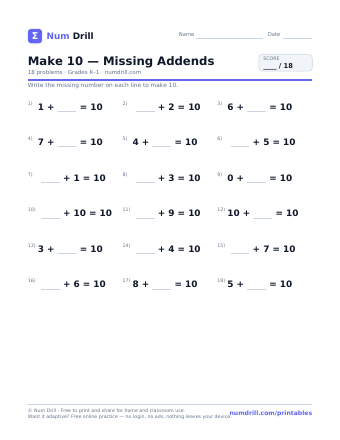
Make 10 — Missing Addends
Grades K–1
Fill in the missing number to make ten. Builds the make-a-ten strategy.
Download PDF (18 problems · 46 KB)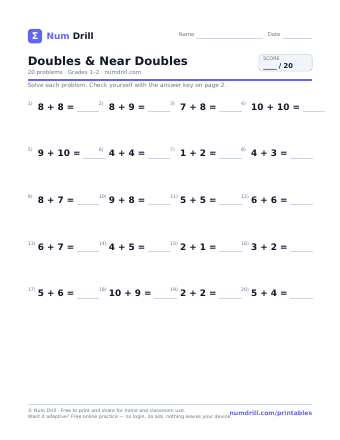
Doubles & Near Doubles
Grades 1–2
Doubles (7+7) and near-doubles (7+8) — the classic mental-math stepping stone.
Download PDF (20 problems · 46 KB)Number bonds and fact families
A number bond and a fact family are the same three numbers drawn two ways. The bond 10, 7, 3 gives the family 7 + 3 = 10, 3 + 7 = 10, 10 − 7 = 3 and 10 − 3 = 7. That is why children who know their bonds find subtraction easier: 10 − 7 is just “what goes with 7 to make 10?”
When kids learn number bonds
- Kindergarten: splitting numbers to 10 into two parts in different ways, and finding the number that makes 10 with any number from 1 to 9.
- 1st grade: making ten to add and subtract within 20, and doubles and near doubles (1st grade math).
- 2nd grade: all sums of two one-digit numbers from memory (2nd grade math).
Bonds on paper, speed on screen
A 10-question adaptive addition quiz finds the facts your child is still counting on and brings them back. Free, no login.
Practise addition factsCommon questions
What is a number bond?
A number bond shows a whole number and two parts that make it, usually as a circle on top joined to two circles below. The bond 10, 7, 3 shows that 7 and 3 make 10.
What are the number bonds to 10?
0 + 10, 1 + 9, 2 + 8, 3 + 7, 4 + 6 and 5 + 5, and the same pairs the other way round (6 + 4, 7 + 3, 8 + 2, 9 + 1, 10 + 0): eleven in all.
What are doubles facts?
Doubles facts add a number to itself, like 4 + 4 = 8 or 7 + 7 = 14. Near doubles are one more or one less: 7 + 8 is 7 + 7 + 1 = 15.
What is the difference between a number bond and a fact family?
They use the same three numbers. A number bond draws them as a whole and two parts; a fact family writes them out as the two addition and two subtraction facts.
What grade learns number bonds?
Kindergarten starts with bonds within 10 and making 10. 1st grade uses them to add and subtract within 20, and by the end of 2nd grade children should know all the sums of two one-digit numbers from memory.
Related: fact families · addition and subtraction practice · addition worksheets · even and odd numbers · all printable worksheets