How to Do Long Division
Long division repeats four steps until there are no digits left:
- Divide the first part of the number by the divisor and write the answer on top.
- Multiply that answer by the divisor and write it underneath.
- Subtract to find what’s left over.
- Bring down the next digit and start again.
Whatever is left at the end is the remainder. Kids remember the order with “Does McDonald’s Sell Burgers?”
Long division step by step
Pick an example or type your own, then press Next step to watch it worked out on paper.
852 ÷ 4 = 213.
Worked example: 852 ÷ 4
| Step | What you do |
|---|---|
| Divide | 4 goes into 8 two times. Write 2 above the 8. |
| Multiply, subtract | 2 × 4 = 8; 8 − 8 = 0. |
| Bring down | Bring down the 5. 4 goes into 5 once: write 1. 1 × 4 = 4; 5 − 4 = 1. |
| Bring down | Bring down the 2 to make 12. 4 goes into 12 three times: write 3. 3 × 4 = 12; 12 − 12 = 0. |
| Answer | 852 ÷ 4 = 213. Check: 213 × 4 = 852. |
Long division with remainders
When the last subtraction doesn’t reach zero, what’s left is the remainder. In 917 ÷ 6 the steps end with 5 left over, so 917 ÷ 6 = 152 R5. The remainder must always be smaller than the divisor. If it isn’t, a digit on top is too small. Later the remainder becomes a fraction (152 5/6) or a decimal.
Zeros in the answer: the most common mistake
Every time you bring down a digit, you must write a digit on top, even if the divisor doesn’t fit. In 1,236 ÷ 12, after 12 ÷ 12 = 1 you bring down the 3, and 12 doesn’t go into 3. Write 0, bring down the 6, and 36 ÷ 12 = 3. The answer is 103, not 13. Checking with multiplication catches this every time: 13 × 12 is only 156.
Dividing by a two-digit number
The steps are the same; only the “divide” step is harder, because the answer isn’t a times-table fact. Round the divisor to estimate: for 107 ÷ 25, think “100 ÷ 25 = 4”, then multiply to check. 4 × 25 = 100, and 107 − 100 = 7, which is less than 25, so 4 is right. If the subtraction comes out bigger than the divisor, go up one; if the multiplication is bigger than the number, go down one. Try 4,075 ÷ 25 in the solver above.
How to check your answer
Multiply the answer by the divisor and add the remainder. You should get the number you started with: 152 × 6 + 5 = 917. It takes ten seconds and catches a skipped zero or a slip in a subtraction.
Before long division: the facts
Most long-division trouble is not the method. It’s a slow “how many 7s are in 52?” at every step. If a child stalls on the divide step, practise the facts with the division chart and division facts practice first, then come back to the algorithm with long division practice.
Long division worksheets
Free PDFs with the bracket drawn and room for the working, each with an answer key.
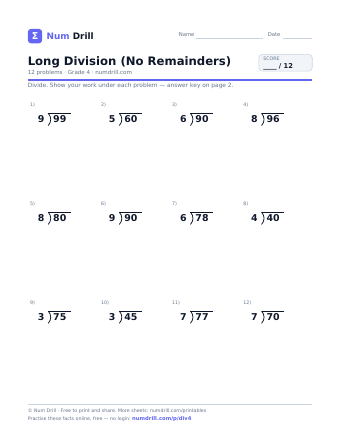
Long Division (No Remainders)
Grade 4
Twelve two-digit by one-digit problems like 84 ÷ 6 that divide exactly.
Download PDF (12 problems · 46 KB)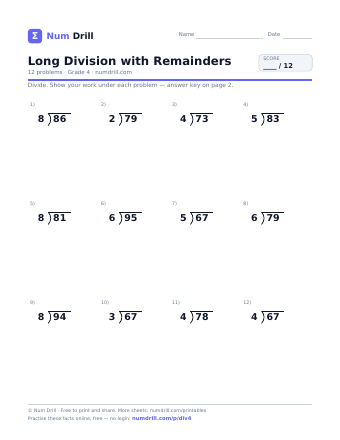
Long Division with Remainders
Grade 4
Twelve two-digit by one-digit problems like 59 ÷ 4 = 14 R3.
Download PDF (12 problems · 46 KB)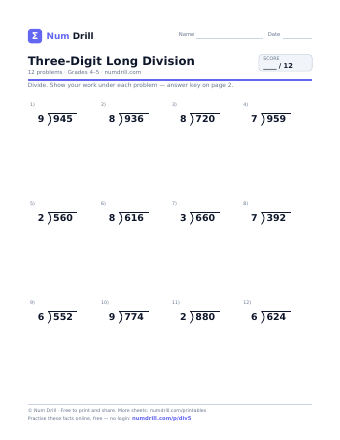
Three-Digit Long Division
Grades 4–5
Twelve three-digit by one-digit problems like 738 ÷ 6, no remainders.
Download PDF (12 problems · 46 KB)More in the division worksheets.
When kids learn it
Long division starts in 4th grade with up to four-digit numbers divided by one-digit numbers, usually with remainders. 5th grade moves to two-digit divisors, and by 6th grade students are expected to divide multi-digit numbers fluently with the standard method. See 4th grade and 5th grade math practice.
Common questions
What are the steps of long division?
Divide, multiply, subtract, bring down, and repeat until there are no digits left. Whatever is left at the end is the remainder. A memory aid is “Does McDonald’s Sell Burgers?”
How do you do long division with remainders?
Do the same steps. When there is nothing left to bring down, the number left after the last subtraction is the remainder: 917 ÷ 6 = 152 R5. It must be smaller than the divisor.
Why do you put a zero in the answer?
Every digit you bring down needs a digit on top. If the divisor doesn’t fit, that digit is 0. Leaving it out is the most common long-division mistake: 1,236 ÷ 12 is 103, not 13.
How do you check a long division answer?
Multiply the answer by the divisor and add the remainder. You should get the number you started with: 152 × 6 + 5 = 917.
What grade learns long division?
4th grade introduces long division by one-digit numbers; 5th grade adds two-digit divisors; 6th grade expects it to be fluent.
Related: long division practice · division chart · division worksheets · division practice · order of operations