Subtraction with Regrouping
Subtraction with regrouping (also called borrowing) is what you do when a digit on top is smaller than the digit below it.
Take 1 from the next place to the left and add 10 to this place. In 52 − 27 you can’t take 7 ones from 2, so trade a ten: 5 tens become 4 and 2 ones become 12. Then 12 − 7 = 5 and 4 − 2 = 2, so 52 − 27 = 25.
Subtraction with regrouping, step by step
Pick an example or type your own. The blocks show what borrowing really does; the numbers show how to write it.
52 − 27 = 25.
How to subtract with regrouping
- Write the numbers in columns, ones under ones and tens under tens.
- Start with the ones. If the top digit is smaller than the bottom digit, regroup.
- To regroup, cross out the digit to the left and write one less above it. Put a 1 in front of the digit you’re working on: 2 becomes 12.
- Subtract the ones, then move left and do the same with the tens, hundreds and so on.
Regrouping never changes the number: 5 tens and 2 ones is the same 52 as 4 tens and 12 ones. It only changes how it’s split up, so there are enough ones to take away.
Subtracting across zeros
The hardest case is a zero where you need to borrow, as in 400 − 156. There are no tens to trade, so go to the hundreds first: 4 hundreds become 3 and the 0 tens become 10. Now trade one of those tens: 10 tens become 9 and the 0 ones become 10. The top number now reads 3 hundreds, 9 tens and 10 ones, still 400, and you can subtract: 10 − 6 = 4, 9 − 5 = 4, 3 − 1 = 2, so 400 − 156 = 244.
A shortcut many teachers use: treat the 40 in 400 as 40 tens, take one away to get 39, and the ones become 10. Same answer, one step.
The most common mistake
Subtracting the smaller digit from the bigger one in each column. In 52 − 27 a child who does 7 − 2 in the ones writes 35. The fix is the rule “top minus bottom, always”: if the top is smaller, regroup. A quick estimate catches it too, because 52 − 27 has to be about 50 − 30 = 20, not 35.
How to check your answer
Add the answer to the number you took away. You should get the top number: 25 + 27 = 52. Addition with regrouping (carrying) is the same idea in reverse, which is why the two are taught together.
Subtraction with regrouping worksheets
Free PDFs with answer keys on page 2.
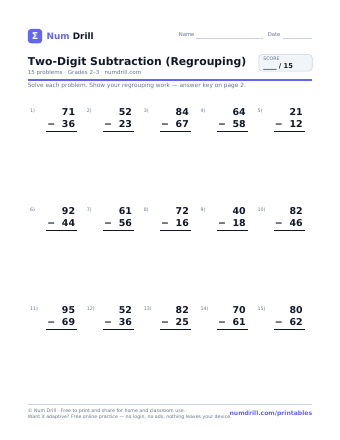
Two-Digit Subtraction (Regrouping)
Grades 2–3
Every problem needs a borrow. Stacked format with room to show work.
Download PDF (15 problems · 46 KB)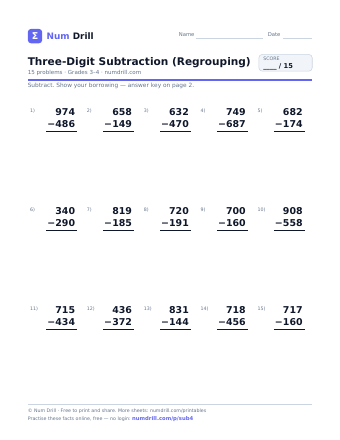
Three-Digit Subtraction (Regrouping)
Grades 3–4
Fifteen stacked problems like 742 − 368 that borrow once or twice.
Download PDF (15 problems · 46 KB)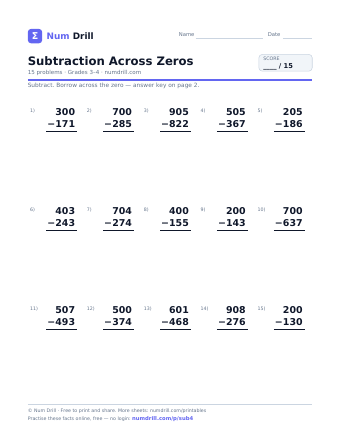
Subtraction Across Zeros
Grades 3–4
Fifteen problems like 400 − 167 and 503 − 258: borrowing through a zero.
Download PDF (15 problems · 46 KB)Facts, no-regrouping sheets and word problems are in the subtraction worksheets.
When kids learn it
Two-digit subtraction with regrouping is a 2nd grade standard (within 100, then within 1,000 using place value). Three-digit subtraction and subtracting across zeros follow in 3rd grade, and by 4th grade students use the standard method fluently with bigger numbers. See 2nd grade and 3rd grade math practice.
Common questions
What is subtraction with regrouping?
Regrouping (borrowing) is trading 1 from the next place for 10 in this place when the top digit is too small to subtract from. In 52 − 27, 5 tens and 2 ones become 4 tens and 12 ones.
Is regrouping the same as borrowing?
Yes. Borrowing is the older name. Schools now say regrouping because nothing is paid back: the number is just split up differently.
How do you subtract across zeros?
Go left to the first digit that isn't zero and regroup from there, one place at a time. For 400 − 156: 4 hundreds become 3, the tens become 10 then 9, the ones become 10. The answer is 244.
How do you check a subtraction answer?
Add the answer to the number you subtracted. You should get the top number: 25 + 27 = 52.
What grade learns subtraction with regrouping?
2nd grade, with two-digit numbers. Three-digit numbers and subtracting across zeros follow in 3rd grade.
Related: subtraction worksheets · addition & subtraction practice · place value chart · how to do long division · all printable worksheets