Prime and Composite Numbers
A prime number has exactly two factors, 1 and itself: 2, 3, 5, 7, 11, 13…
A composite number has more than two factors: 4, 6, 8, 9, 10, 12…
1 is neither, because its only factor is 1.
Prime numbers chart, 1 to 100
The 25 prime numbers below 100 are shaded. Tap any number to see its factor pairs, or run the sieve to find the primes yourself.
The 25 primes below 100 are shaded.
Tap a number to see its factor pairs.
All the prime numbers to 100
2, 3, 5, 7, 11, 13, 17, 19, 23, 29, 31, 37, 41, 43, 47, 53, 59, 61, 67, 71, 73, 79, 83, 89, 97
There are 25 of them. 2 is the only even prime: every other even number can be divided by 2, so it has at least three factors.
Practice: prime or composite?
On a keyboard, press P or C. Watch out for odd numbers like 51 and 91.
The Sieve of Eratosthenes
- Cross out 1. It isn’t prime.
- Circle 2, then cross out every multiple of 2 (4, 6, 8…).
- Circle the next number not crossed out, 3, and cross out its multiples.
- Do the same for 5 and 7.
- Stop there: 11 × 11 = 121 is past 100, so every number left is prime.
It’s the fastest way to make a prime chart by hand, and the prime numbers chart PDF has a blank grid for it on page 2.
Factor pairs
A factor pair is two numbers that multiply to make the number. The factor pairs of 24 are 1 × 24, 2 × 12, 3 × 8 and 4 × 6. Start at 1 and work up; once the two numbers meet or cross, you have them all. A prime number has exactly one factor pair (1 × itself). Times tables fluency makes this quick, which is why the multiplication chart helps here.
Shortcuts for spotting composite numbers
| Divisible by | If… | Example |
|---|---|---|
| 2 | it ends in 0, 2, 4, 6 or 8 (it’s even) | 58 |
| 3 | its digits add up to a multiple of 3 | 51: 5 + 1 = 6 |
| 5 | it ends in 0 or 5 | 85 |
| 9 | its digits add up to a multiple of 9 | 81: 8 + 1 = 9 |
| 10 | it ends in 0 | 70 |
The ones that catch people out are odd numbers that pass all of these: 49 (7 × 7), 77 (7 × 11) and 91 (7 × 13). Below 100, if a number isn’t divisible by 2, 3, 5 or 7, it’s prime.
Prime and composite worksheets
Free PDFs, each with an answer key or a blank version.
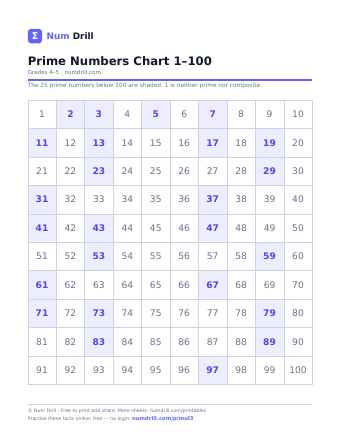
Prime Numbers Chart 1–100
Grades 4–5
The 25 primes below 100 shaded on a hundreds chart, plus a blank Sieve of Eratosthenes on page 2.
Download PDF (47 KB)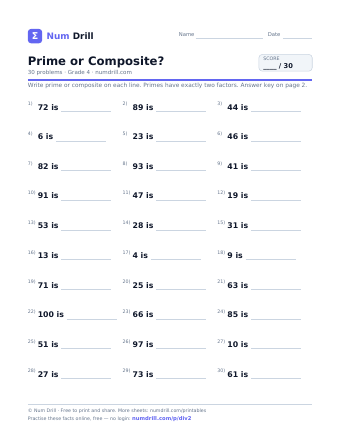
Prime or Composite?
Grade 4
Thirty numbers to 100, including odd ones that only look prime, like 51 and 91.
Download PDF (30 problems · 46 KB)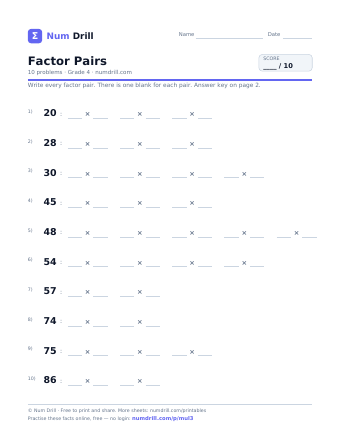
Factor Pairs
Grade 4
Ten numbers to 100 with one blank per factor pair, so you know when you've found them all.
Download PDF (10 problems · 46 KB)When kids learn it
Prime and composite numbers and factor pairs are a 4th grade standard: find all the factor pairs of a whole number from 1 to 100 and decide whether it’s prime or composite. Prime factorization usually follows in 6th grade. See 4th grade math practice.
Common questions
What is a prime number?
A prime number has exactly two factors: 1 and itself. The first prime numbers are 2, 3, 5, 7, 11, 13, 17, 19, 23 and 29.
What is the difference between prime and composite numbers?
A prime number has exactly two factors. A composite number has more than two, so it can be made by multiplying two smaller whole numbers, like 12 = 3 × 4.
Is 1 a prime number?
No. 1 has only one factor, itself, so it is neither prime nor composite.
How many prime numbers are there from 1 to 100?
There are 25: 2, 3, 5, 7, 11, 13, 17, 19, 23, 29, 31, 37, 41, 43, 47, 53, 59, 61, 67, 71, 73, 79, 83, 89 and 97.
What are factor pairs?
Two whole numbers that multiply to give a number. The factor pairs of 24 are 1 × 24, 2 × 12, 3 × 8 and 4 × 6. A prime number has only one pair: 1 and itself.
Related: multiplication chart · hundreds chart · even and odd numbers · division practice · all printable worksheets