Greater Than and Less Than
> means greater than: 7 > 3 is read “7 is greater than 3”.
< means less than: 3 < 7 is read “3 is less than 7”.
The open side always faces the bigger number. = means the two are equal.
Practice: greater than, less than or equal?
On a keyboard, press < = or >.
Greater than and less than symbols
| Symbol | Name | Example | Read it as |
|---|---|---|---|
| > | greater than | 9 > 4 | 9 is greater than 4 |
| < | less than | 4 < 9 | 4 is less than 9 |
| = | equal to | 6 = 6 | 6 is equal to 6 |
| ≥ | greater than or equal to | x ≥ 5 | x is 5 or more |
| ≤ | less than or equal to | x ≤ 5 | x is 5 or less |
Always read the statement from left to right. 9 > 4 and 4 < 9 say the same thing, just starting from a different number.
The alligator trick
Picture the symbol as a hungry alligator’s mouth. It always opens towards the bigger number, because it wants to eat more.
Some children mix up which way the alligator faces. Two other ways to remember it: the small, pointed end points to the smaller number, and the < looks like a slanted L, for “less than”.
How to compare numbers
- Count the digits. A whole number with more digits is bigger: 102 > 98, even though 9 is bigger than 1.
- Same number of digits? Compare from the left. The first place where the digits differ decides it. In 347 and 372 the hundreds match (3 and 3), the tens don’t (4 and 7), so 347 < 372.
- Every digit matches? The numbers are equal.
This is place value at work, which is why a place value chart helps. On a number line the rule is simpler still: the number further to the right is greater.
Comparing fractions
With the same denominator, compare the numerators: 3/8 < 5/8. With the same numerator, the smaller denominator wins, because the pieces are bigger: 1/3 > 1/4. Otherwise, rewrite both with a common denominator, or cross-multiply: for 2/3 and 3/5, compare 2×5 = 10 with 3×3 = 9, so 2/3 > 3/5. Choose Fractions in the practice above to try it.
Common mistakes
- Swapped digits. 34 and 43 use the same digits; the tens digit decides, so 34 < 43.
- Looking only at the first digit when the numbers have different lengths: 9 < 12.
- Reading right to left. 5 < 8 is “5 is less than 8”, not “8 is less than 5”.
- Negative numbers. Further from zero is smaller: −7 < −2.
Greater than, less than worksheets
Free one-page PDFs, each with an answer key on page 2.
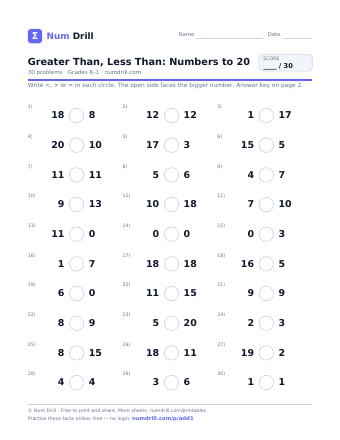
Greater Than, Less Than: Numbers to 20
Grades K–1
Thirty pairs of numbers from 0 to 20: write <, > or = in each circle.
Download PDF (30 problems · 48 KB)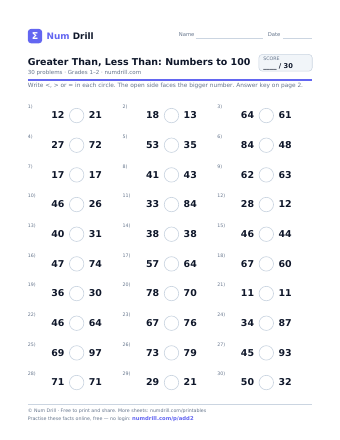
Greater Than, Less Than: Numbers to 100
Grades 1–2
Thirty two-digit pairs, including swapped digits like 34 and 43.
Download PDF (30 problems · 48 KB)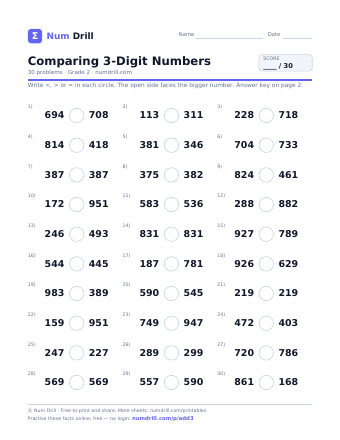
Comparing 3-Digit Numbers
Grade 2
Thirty three-digit pairs where the hundreds often match, so the tens decide.
Download PDF (30 problems · 48 KB)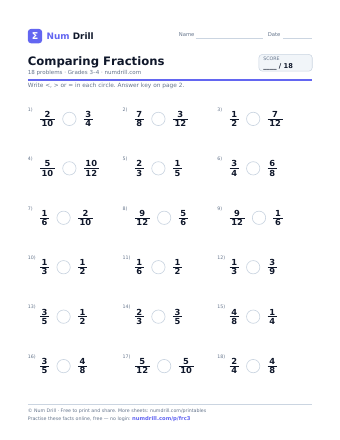
Comparing Fractions
Grades 3–4
Eighteen pairs with different denominators: write <, > or =.
Download PDF (18 problems · 47 KB)When kids learn it
Kindergarten compares groups of objects and numbers up to 10. In 1st grade children compare two-digit numbers and start using the >, < and = symbols; in 2nd grade, three-digit numbers. Comparing fractions comes in 3rd and 4th grade. See 1st grade and 2nd grade math practice.
Common questions
Which is greater than and which is less than?
The > sign means greater than (8 > 5) and the < sign means less than (5 < 8). The open side always faces the bigger number.
What is the alligator trick for greater than and less than?
Think of the symbol as an alligator's mouth. It always opens towards the bigger number because it wants to eat more, so 8 > 5 and 2 < 6.
How do you compare two numbers?
Count the digits first: more digits means a bigger whole number. If they have the same number of digits, compare from the left; the first place where the digits differ decides which is greater.
What do ≥ and ≤ mean?
≥ means greater than or equal to, and ≤ means less than or equal to. x ≥ 5 means x is 5 or more; x ≤ 5 means x is 5 or less.
What grade learns greater than and less than?
Kindergarten compares numbers up to 10, 1st grade compares two-digit numbers with the >, < and = symbols, 2nd grade compares three-digit numbers, and 3rd to 4th grade compares fractions.
Related: number line · place value chart · hundreds chart · fraction worksheets · all printable worksheets